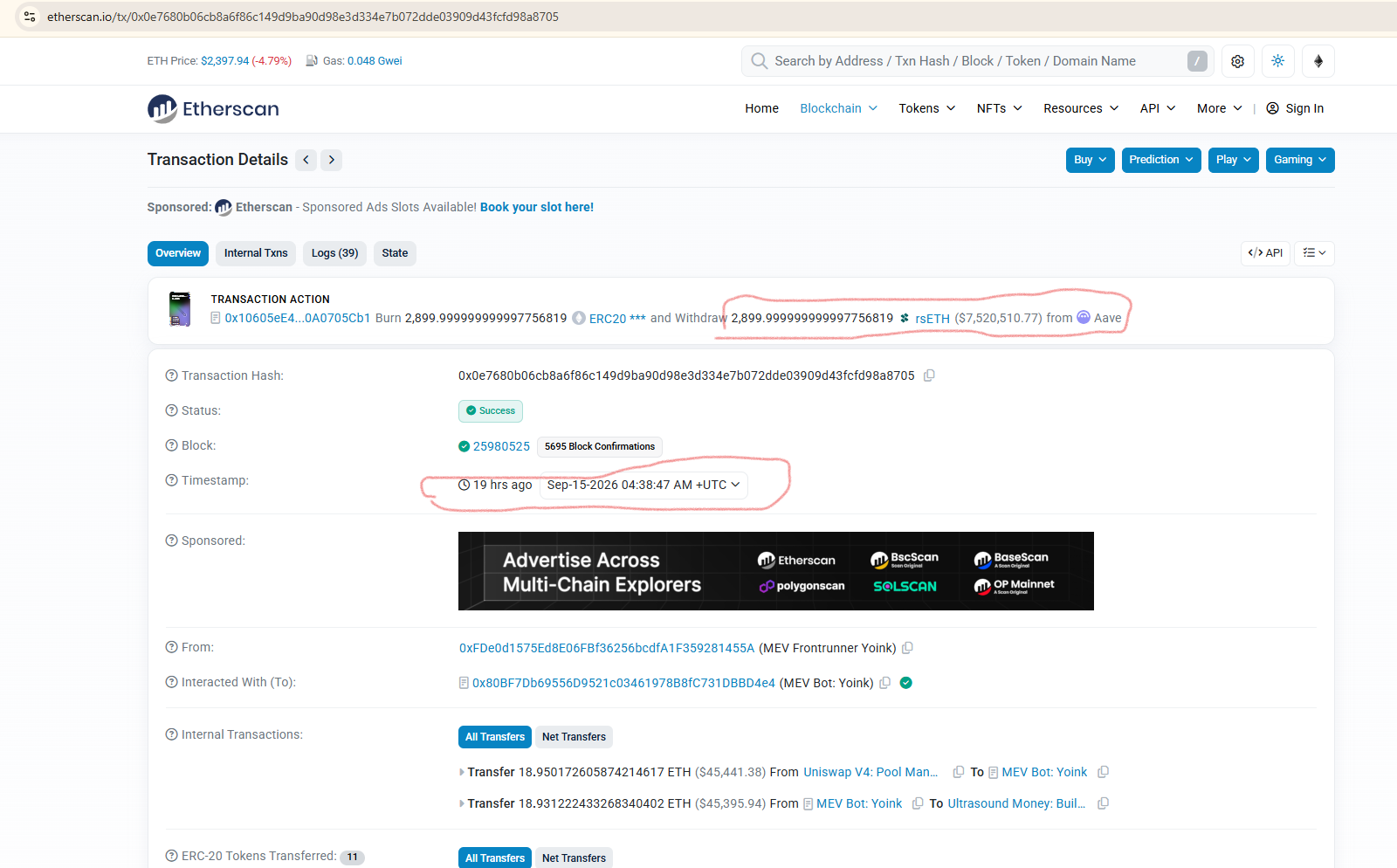

SweepUnclaimedBonus_Drains_Attacker
Summary
A permissionless sweepUnclaimedBonus() between a moderator's SURVIVED flag and a corrective CORRUPTED re-flag irreversibly drains the bonus to recoveryAddress, permanently reducing the whitehat attacker's bounty. The protocol pays the wrong recipient with no recovery path.
Description
sweepUnclaimedBonus does not set claimsStarted (L503), so the re-flag window stays open after the sweep. When riskWindowStart == 0, bonus is unreserved and fully sweepable (L483-487). On re-flag, the snapshot captures the now-zeroed totalBonus (L358), producing a reduced bountyEntitlement:
// ConfidencePool.sol L357-362
snapshotTotalBonus = totalBonus;           // captures zeroed value after sweep
bountyEntitlement = willBeGoodFaithCorrupted
? snapshotTotalStaked + snapshotTotalBonus  // bonus portion is zero
: 0;
Because the snapshot occurs after the sweep, no later code path restores the swept bonus into bountyEntitlement. Reachability of riskWindowStart == 0: The registry requires UNDER_ATTACK before CORRUPTED (AttackRegistry.sol L324). But the pool only seals riskWindowStart on a pool-touching transaction (L793). If approveAttack() and markCorrupted() execute with no pool interaction in between (e.g., same block), riskWindowStart stays zero.
Vulnerability Details
Attack path:
Registry reaches
CORRUPTEDwith no pool interaction duringUNDER_ATTACK—riskWindowStartstays zero.Moderator flags
SURVIVED. No call tostake(),contributeBonus(), orpokeRiskWindow()occurred during the active-risk interval.Anyone calls
sweepUnclaimedBonus()— bonus drains torecoveryAddress,totalBonuszeroed.claimsStartedremains false — moderator re-flags to good-faithCORRUPTED.bountyEntitlement = snapshotTotalStaked + 0. Attacker permanently loses the bonus portion.
Risk
Impact: High — The protocol permanently pays the wrong recipient. The bonus (up to 100% of totalBonus) is irreversibly sent to recoveryAddress instead of the named whitehat attacker. The loss is bounded only by the bonus pool size and is independent of the attacker's exploit performance. Likelihood: Medium — Requires a rare but valid registry path where the pool does not observe the active-risk window before CORRUPTED, combined with a moderator flag correction. The sweep is permissionless and trivially automatable by a MEV bot.
Impact
The whitehat attacker permanently loses their bonus entitlement. In the PoC, the attacker receives 150 tokens instead of the expected 200 — a 25% loss. The swept bonus sits irreversibly at recoveryAddress. No re-flag, no subsequent call, and no admin action can restore it into the attacker's bountyEntitlement.
Proof of Concept
Drop into test/unit/ and run: forge test --match-test testSweepBetweenFlagsReducesAttackerBounty -vvvv The PoC uses MockAttackRegistry (same test double used by all 256 official tests) to stage the CORRUPTED state. In production this is reached via approveAttack() → markCorrupted() with no pool interaction in between.
// SPDX-License-Identifier: MIT
pragma solidity 0.8.26;
import {IAttackRegistry} from "@battlechain/interface/IAttackRegistry.sol";
import {PoolStates} from "src/libraries/PoolStates.sol";
import {BaseConfidencePoolTest} from "test/helpers/BaseConfidencePoolTest.sol";
contract PoC_SweepDrainsBounty is BaseConfidencePoolTest {
function testSweepBetweenFlagsReducesAttackerBounty() external {
_stake(alice, 100 * ONE);
_stake(bob, 50 * ONE);
_contributeBonus(carol, 50 * ONE);
attackRegistry.setAgreementState(IAttackRegistry.ContractState.CORRUPTED);
assertEq(pool.riskWindowStart(), 0);
vm.prank(moderator);
pool.flagOutcome(PoolStates.Outcome.SURVIVED, false, address(0));
pool.sweepUnclaimedBonus();
assertEq(pool.totalBonus(), 0);
assertFalse(pool.claimsStarted());
assertEq(token.balanceOf(recovery), 50 * ONE);
vm.prank(moderator);
pool.flagOutcome(PoolStates.Outcome.CORRUPTED, true, attacker);
assertEq(pool.bountyEntitlement(), 150 * ONE); // should be 200
vm.prank(attacker);
pool.claimAttackerBounty();
assertEq(token.balanceOf(attacker), 150 * ONE);
assertEq(token.balanceOf(recovery), 50 * ONE);
}
}
Tools Used
Manual review, Foundry
Recommended Mitigation
Gate sweepUnclaimedBonus on claimsStarted:
function sweepUnclaimedBonus() external nonReentrant {
if (outcome != PoolStates.Outcome.SURVIVED && outcome != PoolStates.Outcome.EXPIRED) {
revert OutcomeNotEligibleForSweep();
}
+    if (!claimsStarted) revert OutcomeNotEligibleForSweep();
Alternatively, freeze totalBonus at the first flagOutcome and never re-snapshot it on re-flag, decoupling the sweep's accounting from the re-flag's snapshot.
About the author
- Smart contract security researcher.
Comments
Join the discussionNo comments yet. Be the first to comment.